
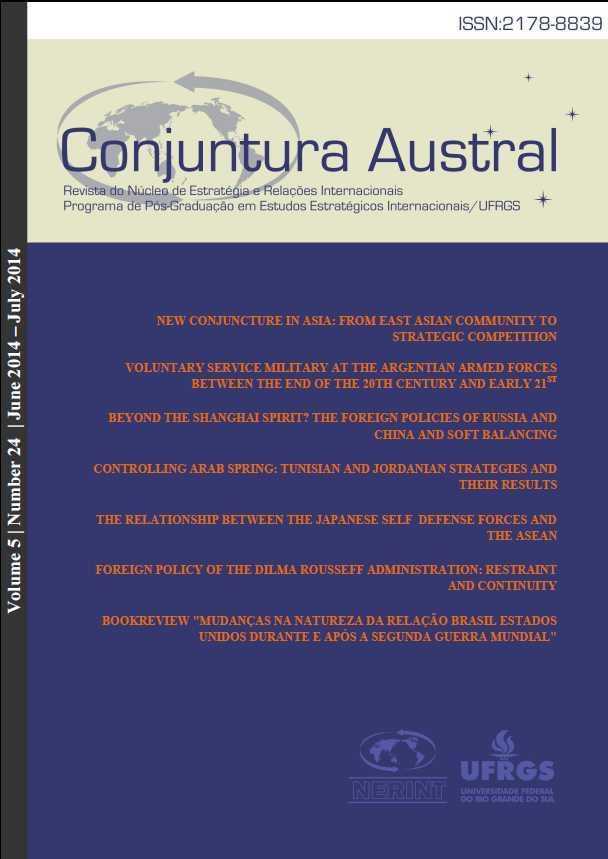
Foreign policy of the Dilma Rousseff administration: restraint and continuity
DOI:
https://doi.org/10.22456/2178-8839.47628Keywords:
Foreign Policy, Foreign Policy Analysis, Brazilian Foreign Policy, Government of Lula da Silva, Government of Dilma RousseffAbstract
Attempting to compare the foreign policy of Dilma Rousseff’s presidency with that of Lula’s presidency, we develop the hypothesis that there has been continuity, although a certain restraint of efforts is observable – restraint caused by the characteristics of the current president, less willing to approach international affairs, and by the international context of economic crisis, that restrain the margin of action available for Brazil. To verify this proposition, characteristics of the foreign policy of both governments are compared through the evaluation of selected variables, comparing gathered data to already available perspectives from area analysts. To explain the identified changes, we use the model of foreign policy analysis developed by Hermann, which considers the profile of leaders, the international conjuncture during each period and other variables capable of influencing the national foreign policy. The conclusion stresses the verification of the hypothesis and the importance of new researches on the theme.
Downloads
Downloads
Published
How to Cite
Issue
Section
License
Authors who publish with this journal agree to the following terms:
a. Authors retain the copyright and grant the journal the right to first publication, with the work simultaneously licensed under the Creative Commons Attribution-Non Commercial-ShareAlike 4.0 International License, which allows its use, distribution and reproduction in any medium, as well as its transformation and creations from it, as long as the original author and source are credited. Also, the material cannot be used for commercial purposes, and if it is transformed, or used as a basis for other creations, these must be distributed under the same license as the original.
b. Authors are able to enter into separate, additional contractual arrangements for the non-exclusive distribution of the journal's published version of the work (e.g., post it to an institutional repository or publish it in a book), with an acknowledgment of its initial publication in this journal.
c. Authors are allowed to deposit, in the repositories accepted by Conjuntura Austral, the preprint version of the manuscripts submitted to the journal prior to and during the submission process, as it can lead to productive exchanges, as well as earlier and greater citation of published work (See The Effect of Open Access)
d. Authors are permitted and encouraged to publish and distribute online (in institutional and /or thematic repositories, on their personal pages, etc.) the postprint version of the manuscripts (accepted and published), without an embargo period.
e. Conjuntura Austral: Journal of the Global South, imbued with the spirit of ensuring the protection of regional academic and scientific production in Open Access, is a signatory to the Mexico Declaration on the use of the Creative Commons BY-NC-SA license to guarantee the protection of academic and scientific production in open access.


