
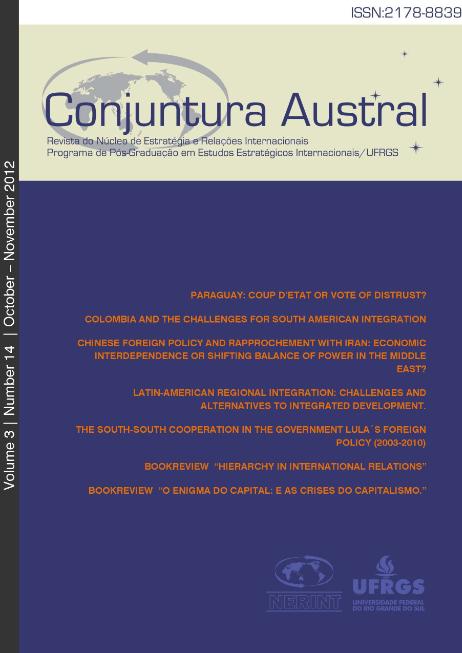
Colombia and the challenges for south american integration
DOI:
https://doi.org/10.22456/2178-8839.31093Keywords:
Colombia, Regional Security, South America, Brazil, UNASUR,Abstract
In this article the authors analyze the first two years of Santos government in Colombia, focusing on its domestic policies, as well as the impacts of its foreign policy over the regional security and the South America’s integration process. Special attention was given to the bilateral relations between Colombia and Brazil. The main conclusion states that the Santos’s foreign policy reorientation lacks consistency. The Colombian normalization of diplomatic and commercial ties with Venezuela and Ecuador is definitely positive for the region, likewise its acceptance and engagement with the UNASUR. However, there are clear limits for the Colombia rapprochement with Brazil, expressed by the signature of a Free Trade Agreement between Colombia and United States, as well as by the Colombian efforts to set up the Pacific Area initiative with Chile and Mexico.Downloads
Downloads
Published
How to Cite
Issue
Section
License
Authors who publish with this journal agree to the following terms:
a. Authors retain the copyright and grant the journal the right to first publication, with the work simultaneously licensed under the Creative Commons Attribution-Non Commercial-ShareAlike 4.0 International License, which allows its use, distribution and reproduction in any medium, as well as its transformation and creations from it, as long as the original author and source are credited. Also, the material cannot be used for commercial purposes, and if it is transformed, or used as a basis for other creations, these must be distributed under the same license as the original.
b. Authors are able to enter into separate, additional contractual arrangements for the non-exclusive distribution of the journal's published version of the work (e.g., post it to an institutional repository or publish it in a book), with an acknowledgment of its initial publication in this journal.
c. Authors are allowed to deposit, in the repositories accepted by Conjuntura Austral, the preprint version of the manuscripts submitted to the journal prior to and during the submission process, as it can lead to productive exchanges, as well as earlier and greater citation of published work (See The Effect of Open Access)
d. Authors are permitted and encouraged to publish and distribute online (in institutional and /or thematic repositories, on their personal pages, etc.) the postprint version of the manuscripts (accepted and published), without an embargo period.
e. Conjuntura Austral: Journal of the Global South, imbued with the spirit of ensuring the protection of regional academic and scientific production in Open Access, is a signatory to the Mexico Declaration on the use of the Creative Commons BY-NC-SA license to guarantee the protection of academic and scientific production in open access.


