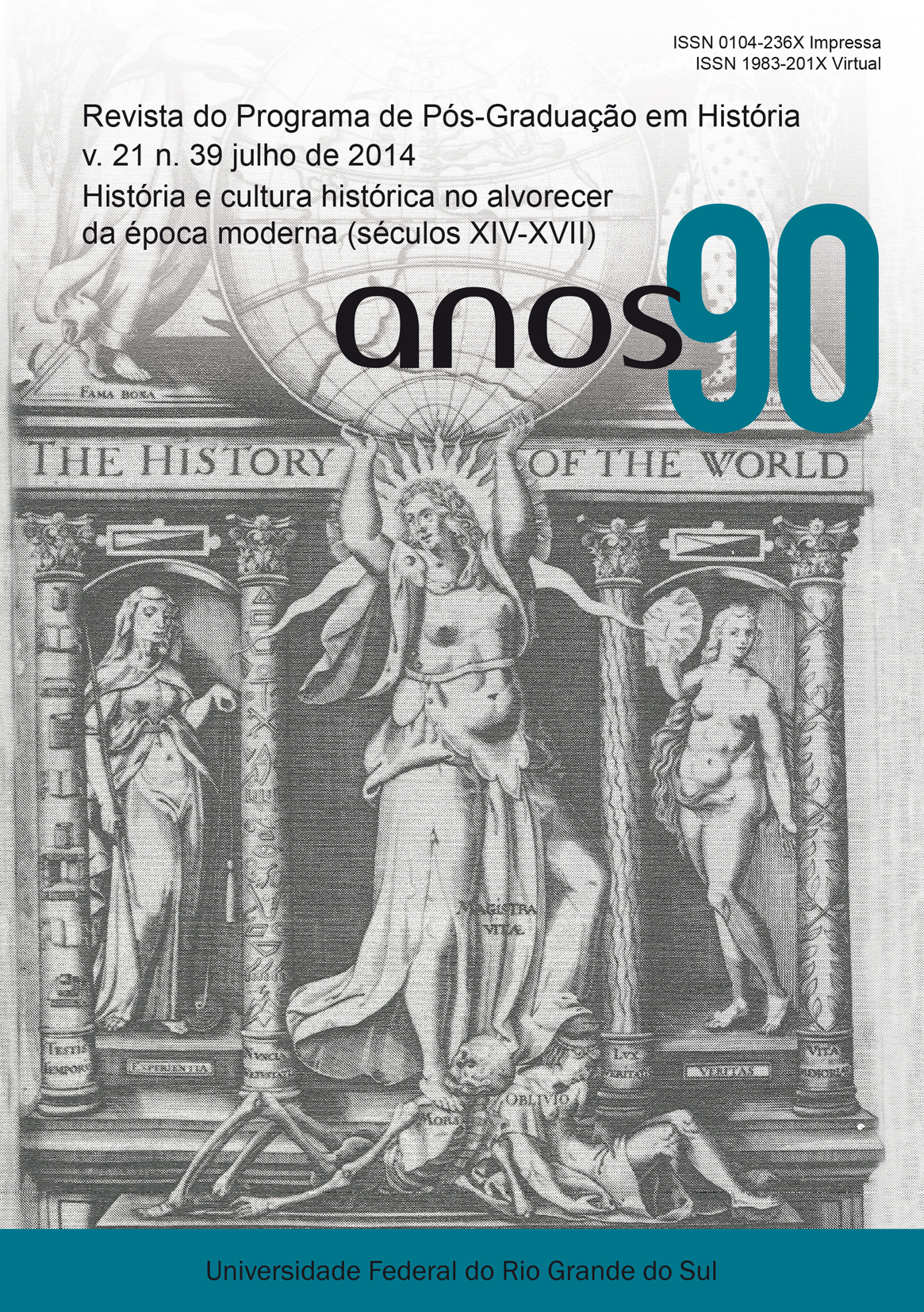
Enea Silvio Piccolomini cosmographer
DOI:
https://doi.org/10.22456/1983-201X.43732Keywords:
Enea Silvio Piccolomini, Pope Pius II, Humanism, Renaissance, CosmographyAbstract
The work of Enea Silvio Piccolomini (1405-1464) constitutes a significant example of humanistic literature from central Italy in the Quattrocento. Poet, cosmographer, eminent orator, political theorist of State, diplomat, Piccolomini followed the religious career and was designated Pope Pius II in 1458. Protagonist in the center of the literary and political events of his time, Pius II was ahead of a pontificate marked by Turks march toward the West. The meeting point between responsibilities as cosmographer, the historian and the narrator traveler, his books that arise here concern us closely: Germania and Historia rerum ubique gestarum, the latter divided into two works idealized as pendant: Europe and Description of Asia. In the first case, it is the exposure of the beauties of the cities in Germania, a narrative that ranges from topographical and geographical descriptions, to the appreciation of the appearance of cities. In the second case, focusing on the description of Asia, we will look for to realize as a most important example of the cosmographical humanistic description in the Renaissance, which one of its main objective is to understand the historical limits between two worlds: the Middle East and Latin Christianity.
Downloads
References
BECCADELLI, Antonio. L’Hermafrodite.Traduit pour la primiere fois par Alcide Bonneau, avec le texte latin e un choix des notes de Forberg. Paris, 1892.
BIRASCHI, Anna Maria; SALMERI, Giovanni (a cura). Strabone e l’Asia Minore. Napoli: Edizione Scientifique Italiane, 2000.
BOCCACCIO, Giovanni. Decameron. (A cura di Vittorio Branca) Volume Primo. Milano: Arnoldo Mondadori Editore, 2004
BRUNI, Leonardo. Laudatio florentine urbs. (A cura di Stefano U. Baldassarri). Tavarnuzze (Firenze): Sismel, 2000.
BURCKHARDT, Jacob. Die Kultur der Renaissance in Italien. In: Gesammenlte Werke, Band III, Basel/Stuttgart: Schwabe, 1978.
D’ASCIA, Luca. Il Corano e la tiara. L’epistola a Maometto di Enea Silvio Piccolomini (Papa Pio II). Bologna: Edizioni Pedragon, 2001.
GARIN, Eugenio. Ritratto di Enea Silvio Piccolomini. In: GARIN, E. Ritratti di umanisti. Milano: Bompiani, 1996.
GHELARDI, Maurizio. La scoperta del Rinascimento. L “Età di Raffaello” di Jacob Burckhardt. Torino: Giulio Einaudi Editore, 1991.
GUGLIELMINETTI, Marziano. Memoria e scritura. L’autobiografia da Dante a Cellini. Torino: Einuadi, 1977.
PAPARELLI, Gioacchino. Introduzione. PICCOLOMINI, Enea Silvio. La Germania. (A cura di Gioacchino Paparelli.) Firenze: Fussi, 1949.
PETRARCA, Francesco. Rerum familiarum libri, XVII-XXIV (Letters on Familiar Matters, Volume 3). The Johns Hopkins University Press, 1984.
PICCOLOMINI, Enea Silvio (Papa Pio II). Descriptión de Asia. Madrid: Alianza Eitorial, 1992.
______. La Germania. (A cura di Gioacchino Paparelli.) Firenze: Fussi, 1949.
______. Storia di due amanti. 3ª ed. Palermo: Sellerio Editore, 1991.
______. (Pio II). I Commentari. 2ª ed. Siena: Edizoni Cantagalli, 1997.
RUNCIMAN, Steven. The Fall of Constantinople 1453. Cambridge University Press, 1965. Edição brasileira: A Queda de Constantinopla 1453. Rio de Janeiro: Imago Editora, 2002.
SALUTATI, Coluccio. Invectiva in Antonium Luschum Vicentinum. In: GARIN, Eugenio (a cura). Prosatori Latini del Quattrocento. Volume I. Torino: Einaudi, 1976.
TOTARO, Luigi. Pio II nei suoi “Commentarii”. Bologna: Pátron Editore, 1978.
UBERTI, Fazio degli. Il Dittamondo. A cura di Marco Prinari. Edizioni digitali del CISVA, 2007.