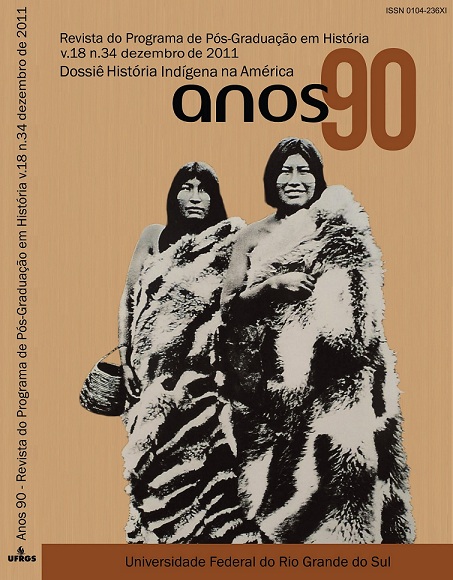
Identities and colonial policies: Christianized Indians, infidels Indians, Portuguese and Spaniards in the River Plate region, c. 1750-1800
DOI:
https://doi.org/10.22456/1983-201X.26263Keywords:
Infidels Indians, Guarani, Borderlands, MissionsAbstract
Until recently, the historiography on the River Plate region presented the relations of alliance prevailing in the region in a very schematic manner: the Christianized Guarani Indians would always be associated to the Spaniards and the Minuano to the Portuguese. Following the new perspectives over the native people history and focusing both the space of the Missions as the southern South America “Campanha” region, such relations have been gradually perceived in its complexity, which also included friendly approaches and even political alliances between the supposedly antagonistic groups. This article intends to approach the interactions between the many agents present at the time, considering the uses that they did of the different spaces and of the imperial commandments, emphasizing on how their initiatives and priorities not always were in line with the strict colonial classifications of the native people.
Downloads
References
ACOSTA Y LARA, Eduardo F. La guerra de los charrúas. Montevidéu: Talleres de Loreto Editores, 1998.
ALMEIDA, Maria Regina Celestino de. Metamorfoses indígenas: identidade e cultura nas aldeias coloniais do Rio de Janeiro. Rio de Janeiro: Arquivo Nacional, 2003.
ALMEIDA, Rita Heloísa de. O Diretório dos índios: um projeto de civilização no Brasil do século XVIII. Brasília: Editora Universidade de Brasília, 1997.
ÁVILA, Carlos Lázaro. “El reformismo borbónico y los indígenas fronterizos americanos”. In: GUIMERÁ, Agustín (ed.). El reformismo borbónico. Madri: Alianza, 1996.
AXTELL, James. The invasion within: the contest of cultures in Colonial North America. New York: Oxford University Press, 1985.
AZARA, Félix. Viajes inéditos de don Félix de Azara desde Santa Fé del Paraguay, y a los pueblos de misiones. Buenos Aires: Imprenta y Librería de Mayo, 1873.
____________. Memoria sobre el estado rural del Rio de la Plata y otros informes. Buenos Aires: Bajel, 1943 [c.1801 – c.1806].
BAUZA, Francisco. Historia de la dominación española en el Uruguay. Montevidéu: Talleres Graficos El Democrata, 1929
BOCCARA, Guillaume. "Mundos Nuevos en las Fronteras del Nuevo Mundo: Relectura de los Procesos Coloniales de Etnogénesis, Etnificación y Mestizaje en Tiempos de Globalización", Mundo Nuevo Nuevos Mundos, revista eletrônica, Paris, 2000. www.ehess.fr/cerma/Revue/debates.htm
BOLTON, Herbert Eugene. “La misión como institución de la frontera en el septentrión de Nueva España” [1917], Estudios (Nuevos y Viejos) sobre la frontera, Anexo 4 Revista de Indias 1990, Madri, CSIC, pp.45-60.
BOXER, Charles. A Igreja e a Expansão Ibérica (1440-1770). Lisboa: Edições 70, 1989.
BRACCO, Diego. Charrúas, guenoas y guaraníes. Interacción y destrucción: indígenas en el Río de la Plata. Montevidéu: Linardi y Risso, 2004.
BROWN, Jennifer; VIBERT, Elizabeth. “Introduction”. In: ___ (eds.). Reading beyond words: contexts for native history. Toronto: Broadview Press, 2003.
CORTESÃO, Jaime; VIANNA, Helio (introdução, notas e sumário). Jesuítas e bandeirantes no Uruguai (1611-1758). Rio de Janeiro: Biblioteca Nacional, 1970.
_________________ (organização e anotação). Alexandre de Gusmão e o Tratado de Madri. parte III: Antecedentes do Tratado, tomo II. Rio de Janeiro: Ministério das Relações Exteriores, Instituto Rio Branco, 1951.
DOMINGUES, Ângela. Quando os índios eram vassalos: colonização e relações de poder no Norte do Brasil na segunda metade do século XVIII. Lisboa: Comissão Nacional para as Comemorações dos Descobrimentos Portugueses, 2000.
FARAGE, Nádia. As muralhas dos sertões: os povos indígenas no Rio Branco e a colonização. Rio de Janeiro: Paz e Terra; ANPOCS, 1991.
FERGUSON, R. Brian; WHITEHEAD, Neil. "The Violent Edge of Empire" In: ___ (eds.). War in tribal zone: expanding states and indigenous warfare. New Mexico: School of American Research Press, 1992.
GARCIA, Elisa Frühauf. As diversas formas de ser índio: políticas indígenas e políticas indigenistas no extremo sul da América portuguesa. Rio de Janeiro: Arquivo Nacional, 2009.
HENIS, Pe. Tadeo Xavier. Diario histórico de la rebelión y guerra de los pueblos guaranís, situados en la costa oriental del río Uruguay, del año de 1754. Alicante: Biblioteca Virtual Miguel de Cervantes, 2002.
HILL, Jonathan. "Introduction", In: ____(org.). History, power and identity: ethnogenesis in the Americas, 1492-1992. Iowa City: University of Iowa Press, 1996.
_____________. "Contested Pasts and the Practice of Anthropology: Overview". American Anthropologist, v.94, n.4, p.811, 1992.
LANDERS, Jane. "Gracia Real de Santa Teresa de Mose: A Free Black Town in Spanish Colonial Florida". The American Historical Review. February, vol.95, n.1. p.21, 1990.
LANGFUR, Hal. “Uncertain Refuge: Frontier Formation and the Origins of the Botocudo War in Late Colonial Brazil”, Hispanic American Historical Review, 82:2, 2002.
MEUWESE, Marcus P. "For the Peace and Well-Being of the Country": Intercultural Mediators and Dutch-Indian Relations in New Netherland and Dutch Brazil, 1600-1664. Tese de PhD em História, Universidade de Notre Dame, EUA, 2003.
MONTEIRO, John. Tupis, tapuias e historiadores. Estudos de história indígena e do indigenismo. Tese apresentada no concurso de livre docência na Universidade Estadual de Campinas. Campinas, 2001.
MORNER, Magnus. La mezcla de razas en la historia de América Latina. Buenos Aires: Paidós, 1969.
ORTELLI, Sara. Trama de una guerra conveniente: Nueva Vizcaya y la sombra de los apaches (1748-1790). México: El Colegio de México, Centro de Estudios Históricos, 2007.
RAPPAPORT, Joanne. "Introduction: Interpreting the Past". In: ____. The Politics of Memory. Cambridge: Cambridge University Press, 1990.
SANTOS, Maria Cristina dos; BAPTISTA, Jean Tiago. “Reduções jesuíticas e povoados de índios: controvérsias sobre a população indígena (séc.XVII-XVIII)”, História Unisinos, 11(2): 240-251, Maio/Agosto 2007.
SCHWARTZ, Stuart; SALOMON, Frank. "New Peoples and New Kinds of People: Adaptation, Readjustment, and Ethnogenesis in South American Indigenous Societies". In: The Cambridge History of the Native Peoples of the Americas. Volume III: South America, part 2. Cambridge New York: Cambridge University Press, 1999.
SIDER, Gerald. "Identity as History. Ethnohistory, Ethnogenesis and Ethnocide in the Southeastern United States". Identities Global Studies in Culture and Power. New Hampshire, vol.1, 1994.
SWEET, David. “The Ibero-American Frontier Mission in Native American History”. In: LANGER, Erick; JACKSON, Robert. The New Latin American Mission History. Lincoln: University of Nebraska Press, 1995.
WEBER, David. “Borbones y bárbaros: centro y periferia en la reformulación de la política de España hacia los indígenas no sometidos”. Anuário IEHS, Tandil, n. 13, p. 147-171, 1998.
_____________. Bárbaros. Los españoles y sus salvajes en la era de la ilustración. Barcelona: Crítica, 2007.
WILDE, Guillermo. Religión y poder en las misiones de guaraníes. Buenos Aires: SB, 2009.