
About the Journal
Focus and Scope
The mission of the journal Para Onde!? is to promote geographical knowledge through the publication of articles, reviews, and interviews related to Geography and related fields, focusing on the themes of environment, Geography education, and territory. The journal issues calls for proposals for special issues and accepts submissions written in Portuguese, Spanish, English, and French.
Peer Review Process
Texts submitted to Para Onde!? are assigned by the Editor-in-Chief to the Associate Editor responsible for the relevant thematic area (Environmental, Education, or Territorial), as shown in the figure below.
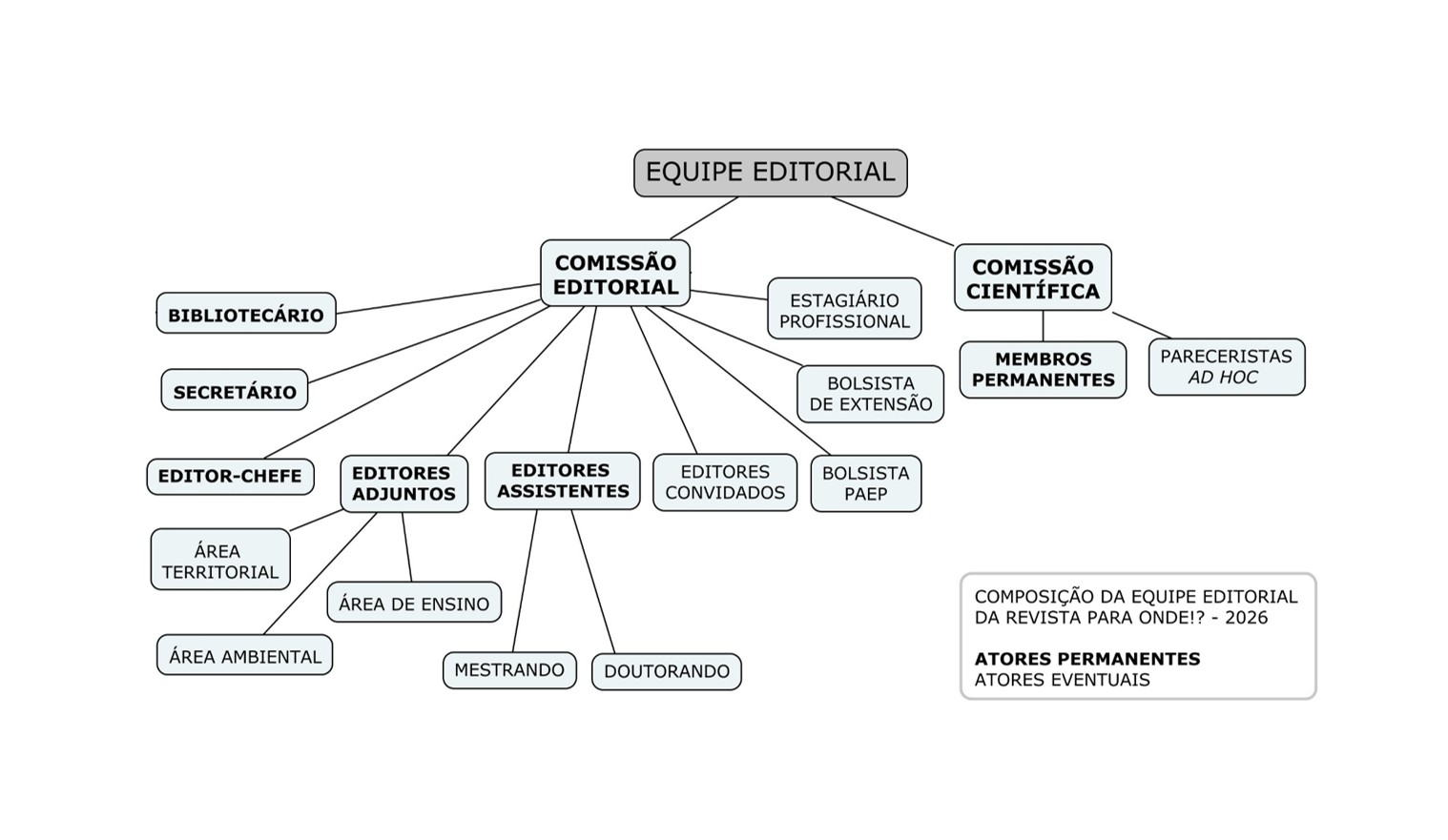
An initial analysis is carried out of the following aspects: adherence to the journal's scope, originality, and formal adequacy. Adherence to DEIA Principles is also evaluated, with special attention to diversity in authorship.
After the (formal) compliance analysis, articles are sent for evaluation by at least two reviewers with recognized qualifications in the field. A double-blind system is adopted for this evaluation. Before receiving a text for review, reviewers agree to the journal's Terms of Use, declaring that they have no conflicts of interest regarding the topic under review, that they will maintain confidentiality, that they will not use artificial intelligence programs in producing their reviews, and that they will respect the ethical foundations of scientific publishing.
Reviews take into account originality, the degree of advancement relative to the state of the art, and the quality of the writing and presentation. The evaluation form can be consulted at the 2026 Evaluation Form. Reviewers are expected to produce informed, constructive, and instructive reviews, in a way that enriches and updates the discussion presented in the manuscript.
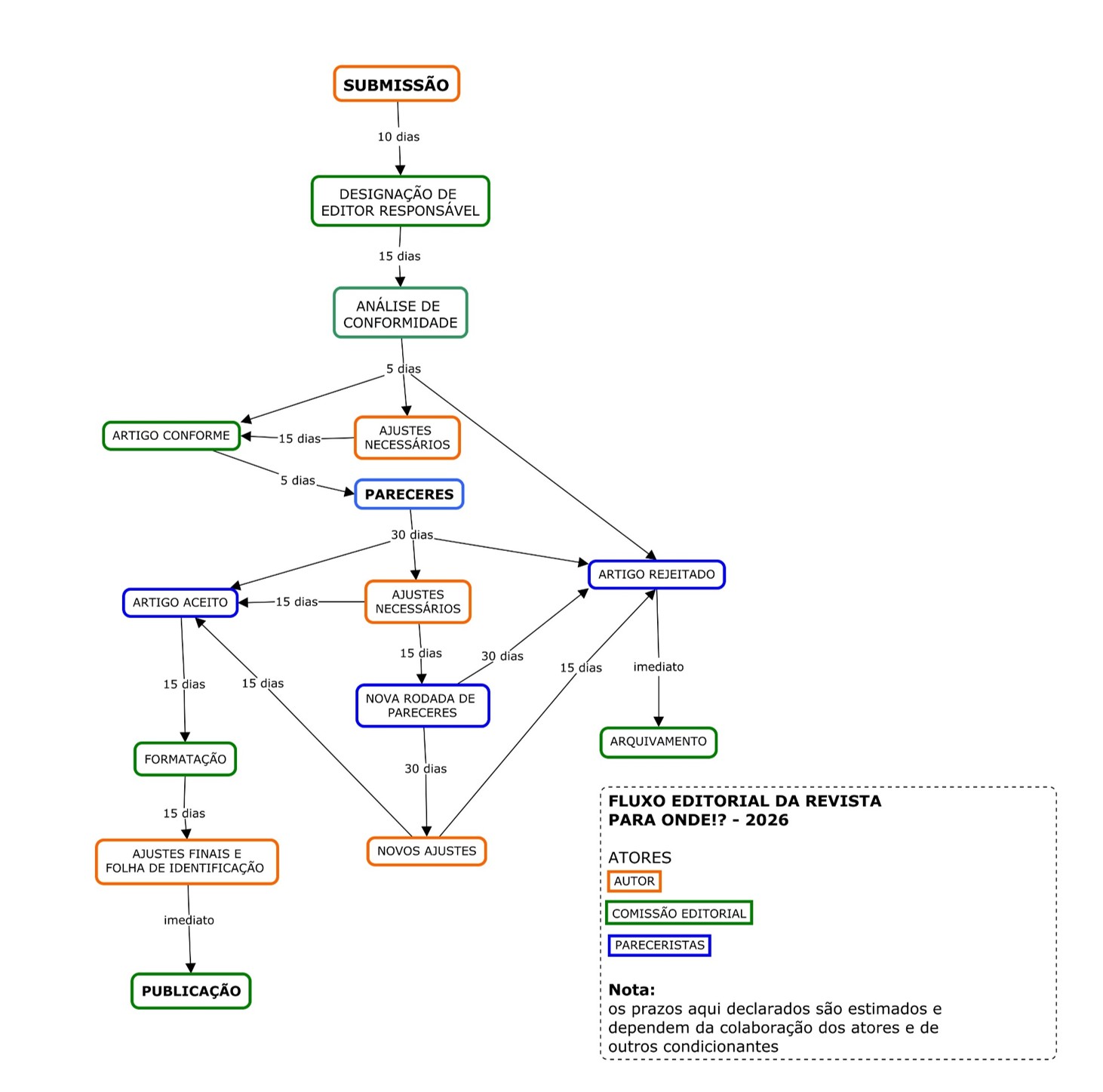
The figure below describes the stages of the editorial workflow and its participants. The timeframes indicated here are estimates and depend on the collaboration of participants and other technical factors.
Open Access and Copyright Policy
This journal provides free and immediate access to its content, based on the principle that making scientific knowledge freely available to the public promotes greater worldwide democratization of knowledge.
The journal adopts the CC BY-NC-SA license (Attribution-NonCommercial-ShareAlike), which allows copying, distribution, modification, and the creation of new works based on the original material, provided that credit is given to the authors (BY), the use is non-commercial (NC), and new works are licensed under identical terms (SA).
The copyright of the works belongs to their authors, who grant the journal the right of first publication. By submitting a manuscript, authors declare that they hold the copyright to the text, that the submitted content is original and unpublished, and that they agree to the journal's open access policy, licensing terms, and publication conditions.
Preservation Strategies
Para Onde!? is preserved in Cariniana - the Brazilian Network of Digital Preservation Services, in LOCKSS - Lots of Copies Keep Stuff Safe, from Stanford University, and in PKP PN - Public Knowledge Project Preservation Network. This aims to prevent the loss of published content in the event of issues with any of these repositories.
Ethics and Integrity in Scientific Practice
The content of articles published by Para Onde!? is the sole responsibility of their authors.
Authors ensure that the submitted work does not contain material that could be interpreted as defamatory or that infringes upon the copyright of third parties.
Authors ensure that the privacy, dignity, and integrity of people involved in the research are respected, as well as that ethical guidelines for research with animals are followed. Where applicable, the article must include the favorable opinion of the Research Ethics Committee of the institution to which the author(s) is/are affiliated.
Regarding matters of authorship and integrity in scientific research, Para Onde!? follows the guidelines on Ethics and Integrity in Scientific Practice established by the Committee appointed by the National Council for Scientific and Technological Development (CNPq), through Ordinance PO-085 of May 5, 2011, as well as the recommendations of the Committee on Publication Ethics (COPE).
Processing Fee
Para Onde!? does not charge submission fees nor processing and publication fees for articles, reviews, and interviews. The journal also does not charge readers to access published articles, being entirely free and open access. The publication is sustained through voluntary work and the ties of staff members to the Public University, which provides labor and technology.
Readers' Commitments
By facilitating open access to recent, high-quality scientific output, readers are expected to read carefully and make judicious use of the information made available in the journal, including responsible citation of sources and appreciation of scientific and editorial work. Readers are expected to actively participate in academic debate, alerting the Editorial Committee to possible disagreements with published content or flaws in editorial production.
Periodicity
Since 2021, Para Onde!? has followed an annual periodicity (one volume and two issues) with a continuous publication flow of articles, reviews, and interviews.
Journal History
Para Onde!? is a project built by the geography community, with more than two decades of history. The idea emerged, and had an initial phase, within the Tutorial Education Program in Geography of the Federal University of Rio Grande do Sul (PET-Geografia/UFRGS), as a journal for researchers, professors, and students of Geography and related fields, disseminating geographical knowledge developed through research, pedagogical experiences, and extension activities. This project became a reality in 2007, with a commemorative edition marking 60 years of the Geography Program and the launch of the first issue of the electronic journal Para Onde!?
The title Para Onde!? represents a search, the walk of knowledge, the Guarani guata, existence in place and in movement, expressed through research, extension, and the many restlessnesses that move and build being and knowing. In this sense, the journal publishes under open access and without processing fees.
In 2011, Para Onde!? officially became the journal of the Graduate Program in Geography at UFRGS (POSGEA UFRGS). The journal became a cornerstone of geographical knowledge produced both within POSGEA and through the exchange of experiences contributed by researchers and students from other institutions.
Its editorial and scientific committees are recognized both nationally and internationally, which strengthens the representativeness of Para Onde!? With each issue, the project launched in 2007 is further consolidated — conceived, developed, and structured collectively.
In recent years, the journal has sought to expand its indexing and qualification, aligning its editorial line with the new challenges presented by the advancement of Brazilian and global scientific publishing, among which we highlight the DEIA principles, in the pursuit of diversity, equity, inclusion, and accessibility.
ISSN - 1982-0003
DOI - https://doi.org/10.22456/1982-0003


