
Metabolic Profile of Holstein Cows: Reference Values in Herds of Rio Grande do Sul - Brazil
DOI:
https://doi.org/10.22456/1679-9216.120192Abstract
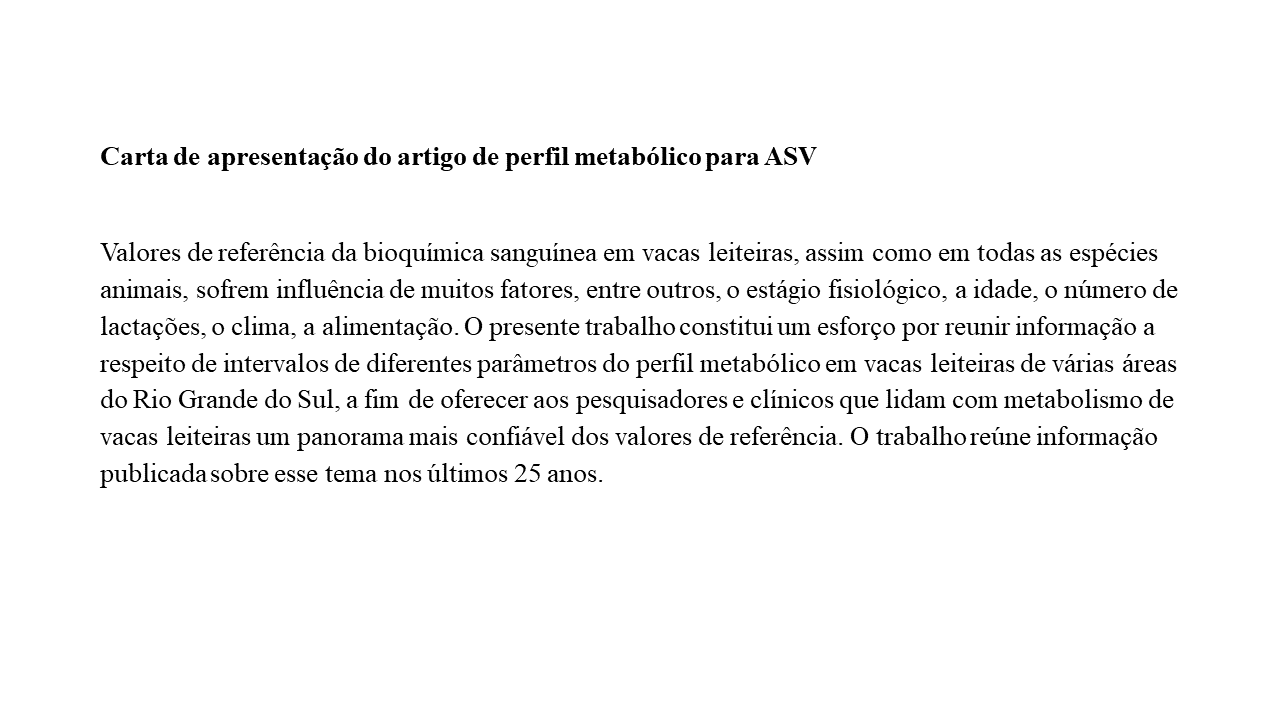
Background: Assessing data from metabolic profile is a complex task depending on individual factors such as breed, age, sex and physiological status and environmental factors such as climate and management. Therefore, reference intervals produced in herds from different geographic regions are not always precise in the local reality. The aim of this study is to compile results of values of the most used parameters in the metabolic profile of healthy Holstein cows, grouped by lactation stage, obtained from studies in Rio Grande do Sul, Brazil, as an effort for the elaboration of regional reference intervals for dairy cattle in this geographic area.
Materials, Methods & Results: The research was defined through the PICO strategy, considering multiparous Holstein cows from scientific studies carried out in Rio Grande do Sul, during the period 1996-2021, in which the nitrogen, glycidic, lipidic, enzymatic or mineral metabolic profile was determined. Google Scholar, Scientific Electronic Library and PubMed were the electronic databases selected for the search, using the following descriptors: "profile" and "metabolic" and "metabolic profile" and "dairy" or "cattle" or "cow" and "Brazil" and "southern" or "Rio Grande do Sul". Studies in Portuguese, English and Spanish languages were considered. The references of the articles initially selected were also verified, through ResearchGate and Google Scholar, in addition to unpublished data, unfinished studies or data in the so called "gray literature". It was possible to identify a total of 34 publications, which were tabulated to assess the scientific quality and bias risk. Studies were evaluated by a pair of independent reviewers, in order to compare results. Eligibility confirmation was given after the complete reading of the articles, evaluating the presence of all the inclusion selection criteria, such as adequate population and the intervention made. Examples of exclusion criteria for studies were studies or data duplication and methodological flaws that could compromise reliability. Thus, of the 34 studies selected in the initial screening, 14 remained. Thereafter, observational studies were preferably sought for data extraction. In the case of clinical trials, only data from control groups were used, in order to avoid disturbances due to interventions or treatments that could be applied. The reference intervals or means of the evaluated metabolites extracted from these studies were grouped in tables, in order to facilitate the comparison with research results obtained in different regions or even for comparison with future studies in the region of interest.
Discussion: This retrospective study obtained mean values and standard deviation of the most used parameters in the metabolic profile of Holstein cows, grouped by lactation stage, obtained from studies performed in the state of Rio Grande do Sul, Brazil. Divergences were observed in several evaluations, especially in values of albumin, beta-hydroxybutyrate, aspartate transaminase and calcium, in spite of all data represented healthy animals from research trials with adequate environment and diet. It is important to consider the risk of time bias in this study, as within this 25-year period there was a very large evolution in dairy farming and some values may not be fully representative of current management systems in Holstein herds. Nevertheless, the results reinforce the importance of using regional reference values for the proper interpretation of metabolic profile results in dairy cows. In addition, the proposing of database index for regional averages or reference intervals, is useful for comparing results of metabolic profiles carried out in different geographic regions, in future studies to be performed in this particular region, or even to be utilized by field practitioners of this particular region.
Keywords: biochemical blood profile, regional reference, healthy cows.
Título: Perfil metabólico de vacas da raça Holandesa:
valores de referência em rebanhos do Rio Grande do Sul - Brasil
Descritores: perfil bioquímico sanguíneo, referência regional, vacas sadias.
Downloads
References
Associação Riograndense de Empreendimentos de Assistência Técnica e Extensão Rural (EMATER). 2019. Relatório socioeconômico da cadeia produtiva do leite no Rio Grande do Sul. Porto Alegre. EMATER, 114p.
Barbosa A.A. 2015. Perfil metabólico e desempenho produtivo de vacas leiteiras com alterações podais. 79f. Porto Alegre, RS. Dissertação (Mestrado em Ciências Veterinárias) - Programa de Pós-Graduação em Ciências Veterinárias, Universidade Federal do Rio Grande do Sul.
Batista C.P., Castro S.M., Correa H.J., Gonçalves R.S., Vale S.F & González F.H.D. 2020. Relation between liver lipid content and plasma biochemical indicators in dairy cows. Acta Scientiae Veterinariae. 48: 1720.
Bondan C., Folchini J.A., Guimarães L., Noro M., Zanella R., Alves L.P., Fontaneli R. & González F.H.D. 2021. Milk yield and composition in dairy cows with post-partum disorders. Arquivo Brasileiro de Medicina Veterinária e Zootecnia. 73(3): 639-646.
Campos R., González F.H.D., Coldebella A. & Lacerda L. 2007. Indicadores do metabolismo energético no pós-parto de vacas leiteiras de alta produção e sua relação com a composição do leite. Ciência Animal Brasileira. 8(2): 241-249.
Cardoso F.C., Esteves V.S., Oliveira S.T., Lasta C.S., Valle S.F., Campos R., Gonzalez F.H.D. 2008. Hematological, biochemical and ruminant parameters for diagnosis of left displacement of the abomasum in dairy cows from Southern Brazil. Pesquisa Agropecuária Brasileira. 43(1): 141-147.
Cozzi G., Ravarotto L., Gottardo F., Stefani A.L., Contiero B., Moro L., Brscic M. & Dalvit P. 2011. Short communication: Reference values for blood parameters in Holstein dairy cows: Effects of parity, stage of lactation, and season of production. Journal of Dairy Science. 94(8): 3895-3901.
Faccio-Demarco C., Mumbach T., Oliveira-de-Freitas V., Fraga R.S.R., Medeiros F.G., Corrêa M.N., Burkert F.A.P., Mendonça H.N.R.F. & Cassal C.B. 2019. Effect of yeast products supplementation during transition period on metabolic profile and milk production in dairy cows. Tropical Animal Health and Production. 51(8): 2193-2201.
Feijó J., Pereira R.A., Montagner P., Pino F.A.B., Schmitt E. & Corrêa M.N. 2017. Dynamics of acute phase proteins in dairy cows with subclinical hypocalcemia. Canadian Journal of Animal Science. 98(1): DOI:10.1139/cjas-2016-0184
García A.M., Cardoso F.C., Campos R., Thedy D.X. & González F.H.D. 2011. Metabolic evaluation of dairy cows submitted to three different strategies to decrease the effects of negative energy balance in early postpartum. Pesquisa Veterinária Brasileira. 31(suppl 1): 11-17.
Goff J.P. 2018. Invited review: Mineral absorption mechanisms, mineral interactions that affect acid–base and antioxidant status, and diet considerations to improve mineral status. Journal of Dairy Science. 101(4): 2763-2813.
Gonçalves R., Schallenberger F., Cardoso F.S.G., Reyes L.J.C. & Gonzalez F.H.D. 2015. Administration of early post-partum oral drench in dairy cows: effect on metabolic profile. Revista de la Facultad de Medicina Veterinaria y de Zootecnia. 62(3): 10-17.
González F.H.D. & Rocha J.A. 1998. Metabolic profile variations and reproduction performance in Holstein cows of different milk yields in southern Brazil. Arquivos da Faculdade de Veterinária UFRGS. 26(1): 52-64.
Kida K. 2002. The Metabolic Profile Test: Its Practicability in Assessing Feeding Management and Periparturient Diseases in High Yielding Commercial Dairy Herds. Journal of Veterinary Medical Science. 64(7): 557-563.
Krause A.R.T., Pfeifer L.F.M., Montagner P., Weschenfelder M.M., Schwegler E., Lima M.E., Xavier E.G., Brauner C.C., Schmitt E., Del Pino F.A.B., Martins C.F., Corrêa M.N. & Schneider. 2014. Associations between resumption of postpartum ovarian activity, uterine health and concentrations of metabolites and acute phase proteins during the transition period in Holstein cows. Animal Reproduction Science. 145(1-2): 8-14.
Lager K. & Jordan E. 2012. The metabolic profile for the modern transition dairy cow. In: Mid-South Ruminant Nutrition Conference (Grapevine, USA). pp.9-16.
Macrae A.I., Whitaker D.A., Burrough E., Dowell A. & Kelly J.M. 2006. Use of metabolic profiles for the assessment of dietary adequacy in UK dairy herds. Veterinary Record. 159(20): 655-661.
Montagner P., Krause A.R.T., Schwegler E., Weschenfelder M.M., Rabassa V.R., Schneider A., Pereira R.A., Brauner C.C., Del Pino F.A.B., Gonçalves F.M. & Corrêa M.N. 2016. Reduction of liver function delays resumption of postpartum ovarian activity and alters the synthesis of acute phase proteins in dairy cows. Research in Veterinary Science. 106: 84-88.
Montagner P., Tavares Krause A.R., Schwegler E., Menoncin Weschenfelder M., Stein A.M., Gularte E.X., Schneider A., Pereira R.A., Jacometo C.B, Schmitt E., Brauner C.C., Del Pino F.A.B. & Corrêa M.N. 2017. Relationship between pre-partum body condition score changes, acute phase proteins and energy metabolism markers during the peripartum period in dairy cows. Italian Journal of Animal Science. 16(2): 329-336.
Payne J.M. 1972. The Compton metabolic profile test. Proceedings of the Royal Society of Medicine. 65(2): 181-183.
Quiroz-Rocha G.F., LeBlanc S.J., Duffield T.F., Wood D., Leslie K.E. & Jacobs R.M. 2009. Reference limits for biochemical and hematological analytes of dairy cows one week before and one week after parturition. The Canadian Veterinary Journal. La Revue vétérinaire Canadienne. 50(4): 383-388.
Rossato W., González F.H.D., Dias M.M., Riccó D., Valle S., Rosa V.L., Conceição T., Duarte F. & Wald V. 2001. Number of lactations affects metabolic profile of dairy cows. Archives of Veterinary Science. 6(2): 83-88.
Saborío-Montero A., Vargas-Leitón B., Romero-Zúñiga J.J. & Sánchez J.M. 2017. Risk factors associated with milk fever occurrence in grazing dairy cattle. Journal of Dairy Science. 100(12): 9715-9722.
Published
Versions
- 2022-03-18 (2)
- 2022-03-08 (1)
How to Cite
Issue
Section
License
This journal provides open access to all of its content on the principle that making research freely available to the public supports a greater global exchange of knowledge. Such access is associated with increased readership and increased citation of an author's work. For more information on this approach, see the Public Knowledge Project and Directory of Open Access Journals.
We define open access journals as journals that use a funding model that does not charge readers or their institutions for access. From the BOAI definition of "open access" we take the right of users to "read, download, copy, distribute, print, search, or link to the full texts of these articles" as mandatory for a journal to be included in the directory.
La Red y Portal Iberoamericano de Revistas Científicas de Veterinaria de Libre Acceso reúne a las principales publicaciones científicas editadas en España, Portugal, Latino América y otros países del ámbito latino


